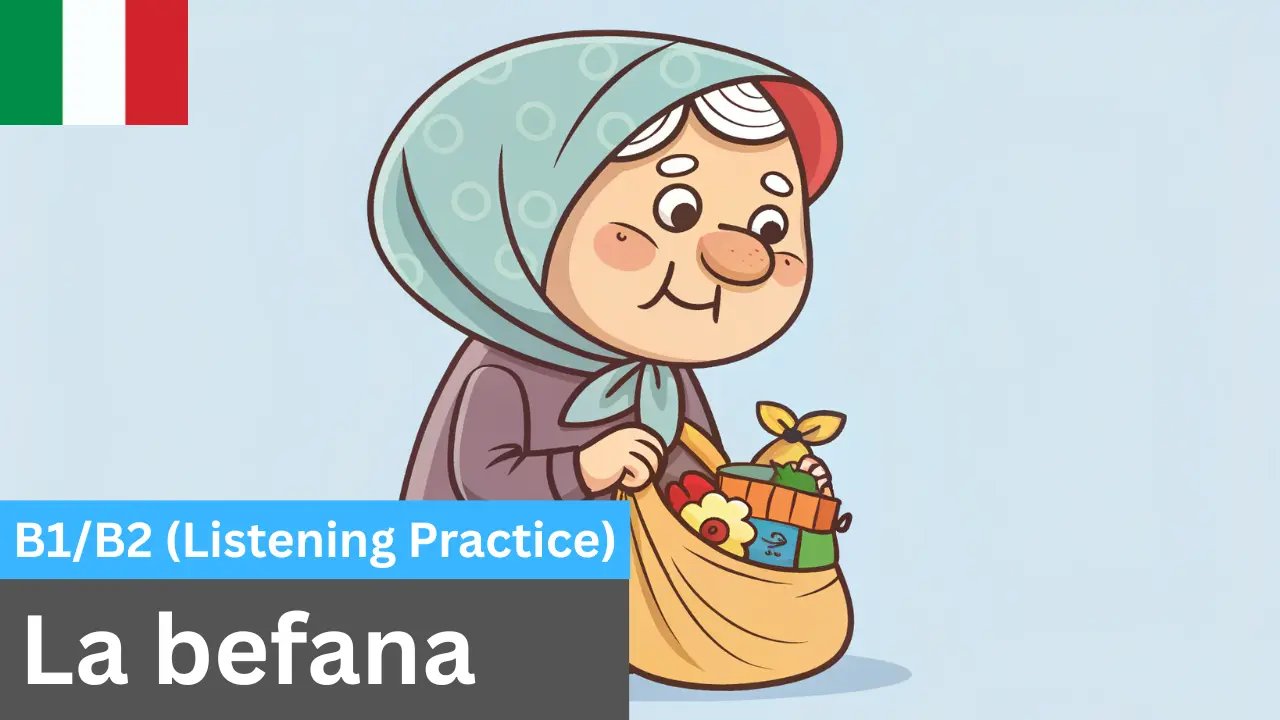
Oggi facciamo un viaggio nel cuore del folklore italiano. (Today we take a journey into the heart of Italian folklore.)
Parleremo di una figura misteriosa e molto amata che arriva subito dopo Natale: la Befana. (We will talk about a mysterious and much-loved figure who arrives right after Christmas: the Befana.)
CONTENUTO PRINCIPALE
In Italia, il periodo natalizio non finisce il 25 dicembre, ma continua fino all'inizio di gennaio. (In Italy, the Christmas season doesn't end on December 25th, but continues until the beginning of January.)
C'è una data molto speciale che tutti i bambini italiani aspettano con ansia: la notte tra il 5 e il 6 gennaio. (There is a very special date that all Italian children wait for anxiously: the night between January 5th and 6th.)
Questa festa si chiama Epifania, ma per la maggior parte delle persone è semplicemente "il giorno della Befana". (This holiday is called Epiphany, but for most people, it is simply "the day of the Befana".)
Ma chi è esattamente la Befana? (But who exactly is the Befana?)
Molti stranieri pensano che sia una strega cattiva perché vola su una scopa, ma la verità è molto diversa. (Many foreigners think she is a wicked witch because she flies on a broomstick, but the truth is very different.)
La Befana è una vecchia signora, povera e vestita di stracci, con un naso lungo e le scarpe rotte. (The Befana is an old lady, poor and dressed in rags, with a long nose and broken shoes.)
Nonostante il suo aspetto un po' spaventoso, è un personaggio buono e generoso che ama i bambini. (Despite her somewhat scary appearance, she is a kind and generous character who loves children.)
La tradizione dice che la Befana entra nelle case attraverso il camino, proprio come Babbo Natale. (Tradition says that the Befana enters houses through the chimney, just like Santa Claus.)
Tuttavia, lei non lascia i regali sotto l'albero. (However, she doesn't leave gifts under the tree.)
I bambini italiani devono appendere delle lunghe calze colorate al camino o vicino alla finestra. (Italian children must hang long colorful stockings by the fireplace or near the window.)
Se i bambini si sono comportati bene durante l'anno, la Befana riempie le calze con caramelle, cioccolatini e piccoli giocattoli. (If the children have behaved well during the year, the Befana fills the stockings with candies, chocolates, and small toys.)
Ma se i bambini sono stati cattivi, o hanno fatto i capricci, troveranno una sorpresa spiacevole: il carbone. (But if the children have been naughty, or have thrown tantrums, they will find an unpleasant surprise: coal.)
Fortunatamente, oggi il "carbone" è fatto di zucchero nero ed è molto dolce, quindi è una punizione deliziosa! (Fortunately, today the "coal" is made of black sugar and is very sweet, so it is a delicious punishment!)
C'è una leggenda molto affascinante che spiega l'origine di questa figura. (There is a very fascinating legend that explains the origin of this figure.)
Si racconta che, tanto tempo fa, i tre Re Magi bussarono alla porta della vecchia signora per chiedere indicazioni verso Betlemme. (It is said that, a long time fa, the three Wise Men knocked on the old lady's door to ask for directions to Bethlehem.)
Loro invitarono la donna a unirsi al viaggio per portare i doni a Gesù Bambino. (They invited the woman to join the journey to bring gifts to Baby Jesus.)
Inizialmente, la Befana rifiutò perché aveva troppe faccende domestiche da finire. (Initially, the Befana refused because she had too many household chores to finish.)
Poco dopo, però, si pentì della sua decisione. (Shortly after, however, she regretted her decision.)
Preparò un sacco pieno di dolci e iniziò a correre per cercare i Re Magi e il bambino, ma non riuscì a trovarli. (She prepared a sack full of sweets and started running to look for the Wise Men and the baby, but she couldn't find them.)
Da quella notte, la Befana vola di casa in casa, lasciando doni a tutti i bambini, nella speranza che uno di loro sia Gesù. (Since that night, the Befana flies from house to house, leaving gifts for all children, in the hope that one of them is Jesus.)
Per questo motivo, è tradizione lasciare un piccolo spuntino per lei la sera del 5 gennaio. (For this reason, it is a tradition to leave a small snack for her on the evening of January 5th.)
Solitamente si lascia un mandarino e un bicchiere di vino, perché si dice che la Befana ami il vino rosso! (Usually, people leave a tangerine and a glass of wine, because it is said that the Befana loves red wine!)
In conclusione, la Befana segna la fine delle vacanze invernali. (In conclusion, the Befana marks the end of the winter holidays.)
C'è un famoso proverbio italiano che dice: "L'Epifania tutte le feste si porta via". (There is a famous Italian proverb that says: "Epiphany takes all the holidays away".)
Il giorno dopo, infatti, si tolgono le decorazioni natalizie e si ritorna alla vita normale. (The next day, in fact, Christmas decorations are taken down and people return to normal life.)
ESPRESSIONI UTILI
Ecco 5 espressioni italiane che abbiamo usato in questa storia e che sono molto utili: (Here are 5 Italian expressions we used in this story that are very useful:)
1. Appendere le calze: Significa mettere le calze sul camino o al muro in attesa dei dolci. (It means to hang the stockings on the fireplace or on the wall waiting for sweets.)
2. Fare i capricci: Si usa quando un bambino piange o si comporta male senza un motivo serio. (It is used when a child cries or behaves badly without a serious reason - to throw a tantrum.)
3. Pentirsi: Significa capire di aver fatto un errore e sentirsi dispiaciuti. (It means to realize you made a mistake and feel sorry - to regret.)
4. Faccende domestiche: Sono i lavori che facciamo per pulire e ordinare la casa. (These are the jobs we do to clean and organize the house - household chores.)
5. Portare via: Significa rimuovere qualcosa o portarlo in un altro posto. (It means to remove something or take it to another place - to take away.)